QWNT x Sera: The Stablecoin FX Strategy Built for Autonomous Agents
QWNT is integrating Sera's stablecoin FX rails into a new agent strategy: simulation first, external-signer live execution next, and a smarter way for users to put idle stablecoins to work.
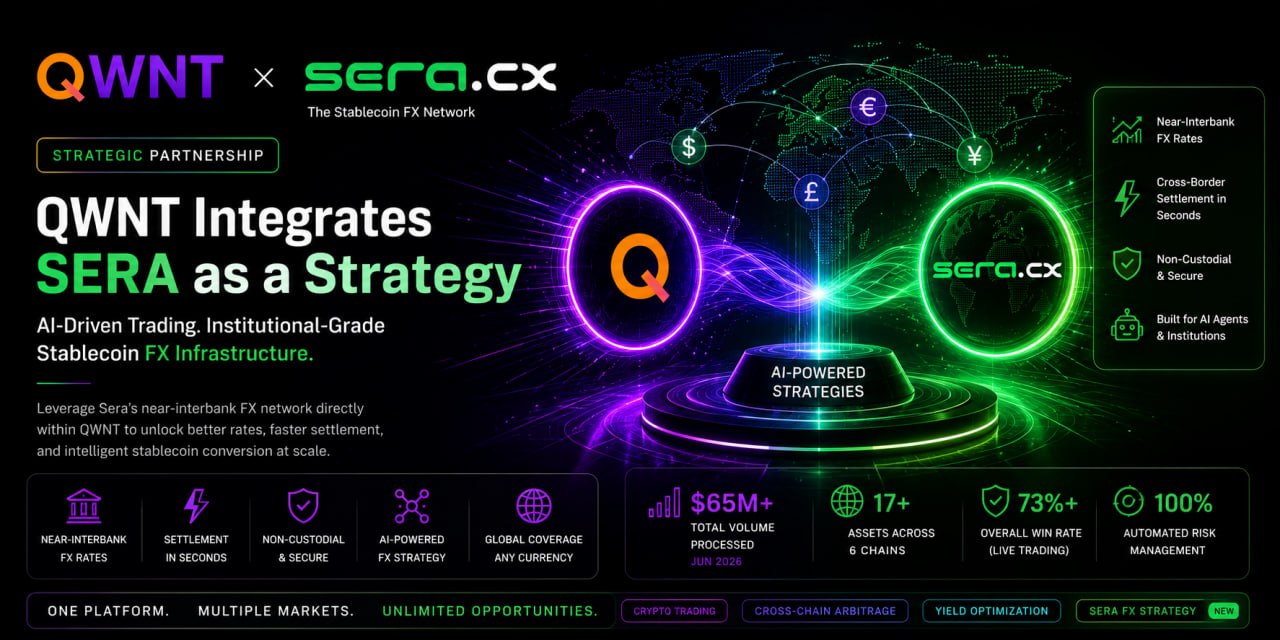
Stablecoins Are Becoming Their Own FX Market
Most people still think of stablecoins as simple digital dollars.
But the real market is bigger than USDC and USDT. There are stablecoins for SGD, EUR, JPY, GBP, MYR, BRL, CAD, AUD, and more. As more money moves on-chain, these currencies need routing, pricing, settlement, and liquidity — the same primitives that power traditional FX, but faster and programmable.
That is where Sera comes in.
Sera is building stablecoin FX settlement rails: a way for wallets, agents, and applications to discover currencies, quote routes, prepare swaps, and settle between multi-currency stablecoins. Its open-source MCP exposes tools for token discovery, market discovery, FX rates, quote preparation, execution, treasury views, and market-making workflows.
For QWNT, this unlocks a new strategy category:
AI-powered stablecoin FX market making.
Not memecoin sniping. Not directional leverage. Not hoping for a chart to go up.
A strategy where idle stablecoin capital can be used to quote stablecoin FX routes, capture spread, rebalance inventory, and turn settlement demand into potential yield.
What QWNT Is Building With Sera
The first QWNT x Sera strategy is the Sera Stablecoin FX Market Maker.
The strategy is designed to let a user allocate stablecoin capital into an autonomous agent that watches Sera markets and identifies where liquidity can be useful.
At a high level, the agent can:
- Read Sera token and market data.
- Monitor stablecoin FX corridors like USD, SGD, EUR, JPY, GBP, MYR, and others.
- Simulate market-making spreads before real capital is used.
- Prepare Sera swap intents using real EIP-712 route parameters.
- Let the user or approved signer externally sign transactions.
- Submit live execution only when server-side live mode and risk controls are enabled.
That last part matters.
The QWNT Go backend does not store a private key for this integration. Live execution is built around an external-signer model: the backend prepares the Sera intent, the wallet signs it, and the system can submit it only when live execution is explicitly enabled.
This gives QWNT users a safer path from simulation to live deployment.
Why This Strategy Is Different From Normal Yield Farming
Most DeFi yield comes from one of a few sources:
- lending demand
- liquidity pool fees
- incentives/emissions
- funding rates
- directional market risk
Sera-style stablecoin FX market making is different.
The potential edge comes from helping stablecoin users move between currency denominations. If someone wants to move from a USD stablecoin into an SGD, EUR, JPY, or MYR stablecoin route, liquidity has value. A market maker can quote a price, take the other side, and earn spread if the trade is filled and inventory is managed correctly.
That makes the strategy attractive because it is not purely dependent on token price speculation.
The core game becomes:
- quote intelligently
- avoid bad fills
- control inventory drift
- rebalance when exposure gets too high
- track realized spread and net PnL
- avoid overtrading illiquid routes
This is exactly the kind of task autonomous agents are good at.
Humans do not want to watch 780 stablecoin FX markets all day.
Agents can.
How Users Can Use It To Their Advantage
The Sera strategy is designed for users who want a lower-volatility agent category inside QWNT.
Instead of allocating only to high-beta strategies like memecoin sniping or trend trading, a user can eventually allocate part of their portfolio to a stablecoin FX agent.
Potential advantages:
1. Put Idle Stablecoins To Work
Many users keep USDC sitting idle between trades. A Sera-powered QWNT agent gives that capital a job: quote stablecoin FX opportunities and attempt to earn spread.
2. Diversify Away From Directional Crypto Risk
A stablecoin FX strategy is not the same as buying a volatile token and hoping it appreciates. The risk profile is different: inventory risk, liquidity risk, settlement risk, and execution risk matter more than pure market direction.
That makes it a useful complement to QWNT's more aggressive agents.
3. Start In Simulation Before Going Live
QWNT's integration is simulation-first.
Users can test:
- which currency pair they want to route
- what notional size they want to simulate
- conservative, standard, or aggressive spread styles
- projected edge per fill and per round trip
- whether Sera currently has available liquidity for a quote
This lets users understand behavior before real execution.
4. Use External Signing For Safer Live Execution
When live execution is enabled, the intended flow is not “trust a black box with a private key.”
The safer flow is:
- QWNT prepares the Sera route.
- The wallet receives EIP-712 typed data.
- The user or approved signer reviews and signs.
- QWNT submits the signed intent.
- The dashboard tracks status, fills, PnL, and exposure.
This gives users better transparency into what the agent is preparing to do.
5. Choose A Risk Style
The QWNT strategy can support different spread styles:
- Conservative — wider spreads, fewer fills, lower churn.
- Standard — balanced spread capture and fill probability.
- Aggressive — tighter quotes, more potential fills, more inventory movement.
Different users have different goals. A stablecoin treasury may prefer conservative execution. A more active user may prefer tighter quotes and higher turnover.
What Is Live Today
The QWNT Go integration already supports the foundation for the strategy.
Live on the Go test environment:
- Sera health/config checks
- token discovery
- market discovery
- simulation engine
- maker ladder projections
- live quote preparation
- external-signer EIP-712 route preparation
- gated execution endpoint
- gated order endpoint
The current production posture is intentionally conservative:
Simulation and quote preparation are available. Live writes stay gated until live mode is deliberately enabled.
That is the right approach for financial infrastructure.
Move fast on product experience. Move carefully on funds.
What Happens When A User Allocates Liquidity?
For users who opt into the Sera/QWNT strategy, the allocated capital is intended to support Sera stablecoin FX activity.
In simple terms:
The user allocates capital to the strategy, and the agent can use that capital to quote, rebalance, and capture spread on Sera rails.
Important distinction: this is not automatic for every QWNT user. It is a strategy choice. Only users who select the Sera strategy and allocate funds to it would have capital routed into that strategy's workflow.
The dashboard should make this clear:
- how much capital is allocated
- which currencies are supported
- what risk style is selected
- what quotes are being prepared
- what fills occurred
- what PnL was realized
- what inventory is currently held
- whether live execution is enabled or simulation-only
That transparency is critical.
Why Go Matters For This Integration
QWNT's Sera integration is being built into the new Go backend layer.
The reason is simple: latency-sensitive routing, quote preparation, simulation, and execution orchestration benefit from a fast, concurrent backend service.
Go gives QWNT:
- faster request handling
- cleaner isolated services
- better concurrency for market scans
- simpler production deployment
- a strong foundation for future execution engines
The dashboard can stay in Next.js. The agent and market infrastructure can move into Go where speed and reliability matter most.
This is the direction QWNT is heading: a frontend users love, backed by faster autonomous trading infrastructure.
The Bigger Picture
QWNT is not just building trading bots.
QWNT is building the operating system for autonomous on-chain trading agents.
Sera expands what those agents can do.
With Sera, QWNT agents can move beyond directional crypto trades into stablecoin FX settlement, treasury routing, and market-making infrastructure. That opens the door to a more balanced strategy marketplace:
- high-upside agents for traders
- stablecoin strategies for yield seekers
- treasury tools for teams
- institutional dashboards for larger allocators
- multi-currency settlement agents for global users
This is where AI agents become more than execution scripts.
They become financial operators.
Final Thought
The future of on-chain trading is not one bot running one strategy.
It is a network of specialized agents, each operating across different market structures: memecoins, arbitrage, yield, prediction markets, perps, and now stablecoin FX.
The Sera integration gives QWNT a new category: autonomous stablecoin FX intelligence.
For users, that means more ways to deploy capital.
For QWNT, it means another step toward becoming the infrastructure layer for autonomous finance.
This article is for informational purposes only. Stablecoin FX strategies carry risks, including liquidity risk, execution risk, smart contract risk, inventory risk, and market risk. Simulated results and projected yield are not guarantees of future performance. Always review risk disclosures before deploying live capital.